Introduction
Choosing where to build your life is about far more than scenery or salary. In 2026, best and worst countries to live in 2026 can differ dramatically depending on quality of life, healthcare, safety, affordability, career opportunities, and social stability. For Americans considering a move abroad, these differences matter even more because taxes, visas, language, housing, and access to familiar services can reshape the experience. Some nations stand out for peaceful communities, excellent public services, and enviable work-life balance. Others face conflict, economic hardship, or serious instability. This guide ranks leading destinations using several major indicators rather than relying on one narrow scoreboard. The result offers a clearer picture of where life may genuinely feel better.
Choosing where to live in 2026 isn’t simply about finding the richest country. Safety, healthcare, education, income, housing, pollution, freedom, infrastructure, and social trust can dramatically change everyday life. The latest international data paints a fascinating picture: some smaller nations outperform much wealthier countries, while several struggling states remain near the bottom.
This ranking combines several respected indicators rather than relying on one league table. The 2025 UNDP Human Development Report measures health, education, and living standards across 193 countries. Meanwhile, the 2026 World Happiness Report examines how people evaluate their own lives. Numbeo’s 2026 Quality of Life Index adds practical factors such as purchasing power, safety, healthcare, pollution, traffic, housing costs, and climate.
The Best Countries to Live In 2026
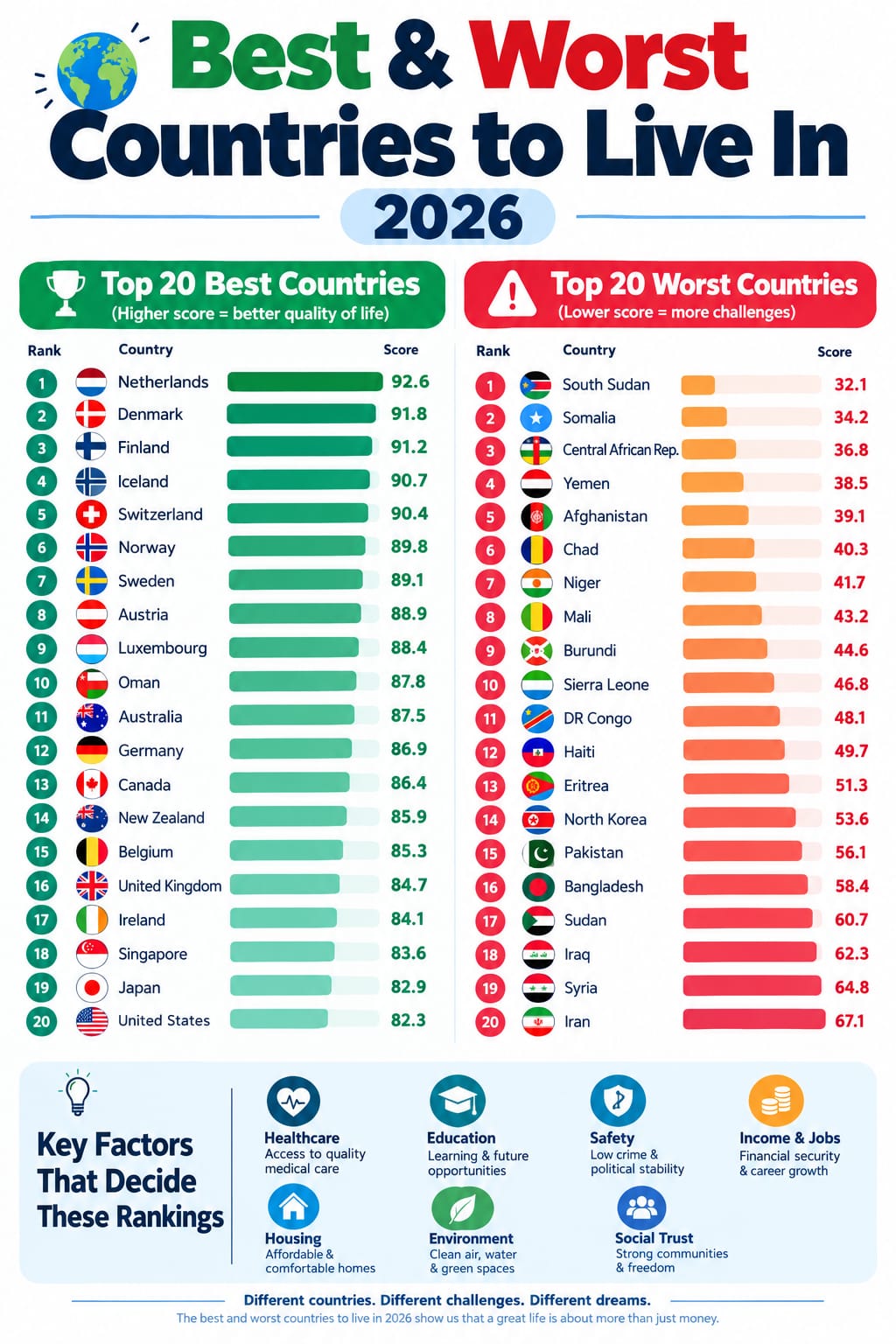
The strongest places combine prosperity with everyday comfort. The best and worst countries to live in 2026 look very different when safety, healthcare, education, income, and personal wellbeing are considered together. Nordic and Western European nations dominate several measures, although countries such as Oman and Costa Rica deliver surprising performances.
Rank Country Why it stands out
1 🇳🇱 Netherlands Excellent quality of life, healthcare, infrastructure
2 🇩🇰 Denmark Strong incomes, safety, welfare, and social trust
3 🇫🇮 Finland Exceptional happiness, education, and public services
4 🇮🇸 Iceland Safety, wellbeing, clean environment, high development
5 🇨🇭 Switzerland High incomes, healthcare, stability, and infrastructure
6 🇳🇴 Norway Wealth, social protection, nature, and strong institutions
7 🇸🇪 Sweden Education, healthcare, innovation, and social security
8 🇦🇹 Austria Healthcare, infrastructure, safety, and livable cities
9 🇱🇺 Luxembourg Extraordinary purchasing power and strong public services
10 🇴🇲 Oman Safety, purchasing power, affordability, and climate
The Netherlands deserves particular attention because it leads Numbeo’s 2026 Quality of Life Index. It records a quality-of-life score of 213.6, supported by strong purchasing power, healthcare, safety, climate, and relatively low pollution. Denmark follows closely at 212.2, while Luxembourg reaches 211.9.
Happiness tells a slightly different story. Finland remains number one in the 2026 World Happiness Report, followed by Iceland, Denmark, Costa Rica, Sweden, and Norway. The report uses people’s own evaluations of their lives and considers factors including income, healthy life expectancy, social support, freedom, generosity, and perceived corruption.
Interestingly, Costa Rica breaks the European pattern. It reached fourth place globally in the 2026 happiness ranking, its best-ever position. That result shows why money alone cannot define a great country to live in. Strong communities, social connections, freedom, and satisfaction with life can matter just as much as a large salary.
For anyone prioritizing education and long-term development, the UNDP ranking offers another useful perspective. Iceland occupies the top position in the latest Human Development Index, followed by Norway and Switzerland. Denmark, Germany, Sweden, Australia, Hong Kong, the Netherlands, and Belgium also appear among the top ten.
The Worst Countries to Live In 2026
Life becomes much harder when conflict, poverty, weak institutions, and limited services overlap. The worst countries to live in 2026 shouldn’t be interpreted as judgments about their people or cultures. Instead, these rankings highlight difficult living conditions created by war, economic instability, weak healthcare, poor infrastructure, insecurity, or severe deprivation.
Group Country Major challenges
1 🇸🇸 South Sudan Conflict, poverty, weak infrastructure
2 🇸🇴 Somalia Security problems, poverty, limited services
3 🇨🇫 Central African Republic Conflict, poverty, fragile institutions
4 🇾🇪 Yemen War, humanitarian crisis, economic hardship
5 🇦🇫 Afghanistan Poverty, restrictions, limited opportunities
6 🇹🇩 Chad Low development, poverty, infrastructure gaps
7 🇳🇪 Niger Poverty, insecurity, limited public services
8 🇲🇱 Mali Conflict, insecurity, economic challenges
9 🇧🇮 Burundi Low incomes, poverty, development constraints
10 🇸🇱 Sierra Leone Low development, healthcare and infrastructure challenges
The UNDP data provides a clearer statistical picture of these difficulties. Its latest report places Pakistan at 168th out of 193 countries, with an HDI of 0.544 and a classification of low human development. The report also shows that inequality substantially reduces Pakistan’s inequality-adjusted HDI.
Conflict remains one of the biggest dividing lines. The 2026 World Happiness Report notes that countries experiencing major conflict remain near the bottom of its rankings. War can damage healthcare systems, destroy infrastructure, disrupt education, reduce employment, and create uncertainty that affects almost every part of daily life.
However, a low ranking doesn’t mean every city or community is equally difficult. Countries contain enormous regional differences. A capital city might have better hospitals, universities, internet access, transport, and employment than remote rural areas. Likewise, a country with a low national score can still offer welcoming communities, beautiful landscapes, affordable living, and strong cultural traditions.
How Were the Rankings Chosen?
No single index can perfectly determine the best and worst countries to live in 2026. This ranking therefore compares human development, happiness, safety, healthcare, purchasing power, pollution, infrastructure, affordability, and social conditions. UNDP provides the broad development picture, while the World Happiness Report captures lived experience and Numbeo adds practical everyday measures.
For the most reliable comparison, readers should examine several indicators together rather than obsessing over one position. A wealthy country may have expensive housing, while a cheaper country may have weaker healthcare. Similarly, a highly developed country can still struggle with pollution or loneliness. The best choice depends on what matters most to you.
Bottom line: the best and worst countries to live in 2026 reveal a world where quality of life depends on much more than GDP. Northern Europe continues to dominate happiness and development measures, while countries affected by conflict and severe poverty face the greatest obstacles. For students, families, professionals, and retirees, the smartest approach is to compare the factors that directly shape everyday life.
Best and worst countries to live in 2026 ranked by safety, healthcare, happiness, affordability, quality of life, and stability.