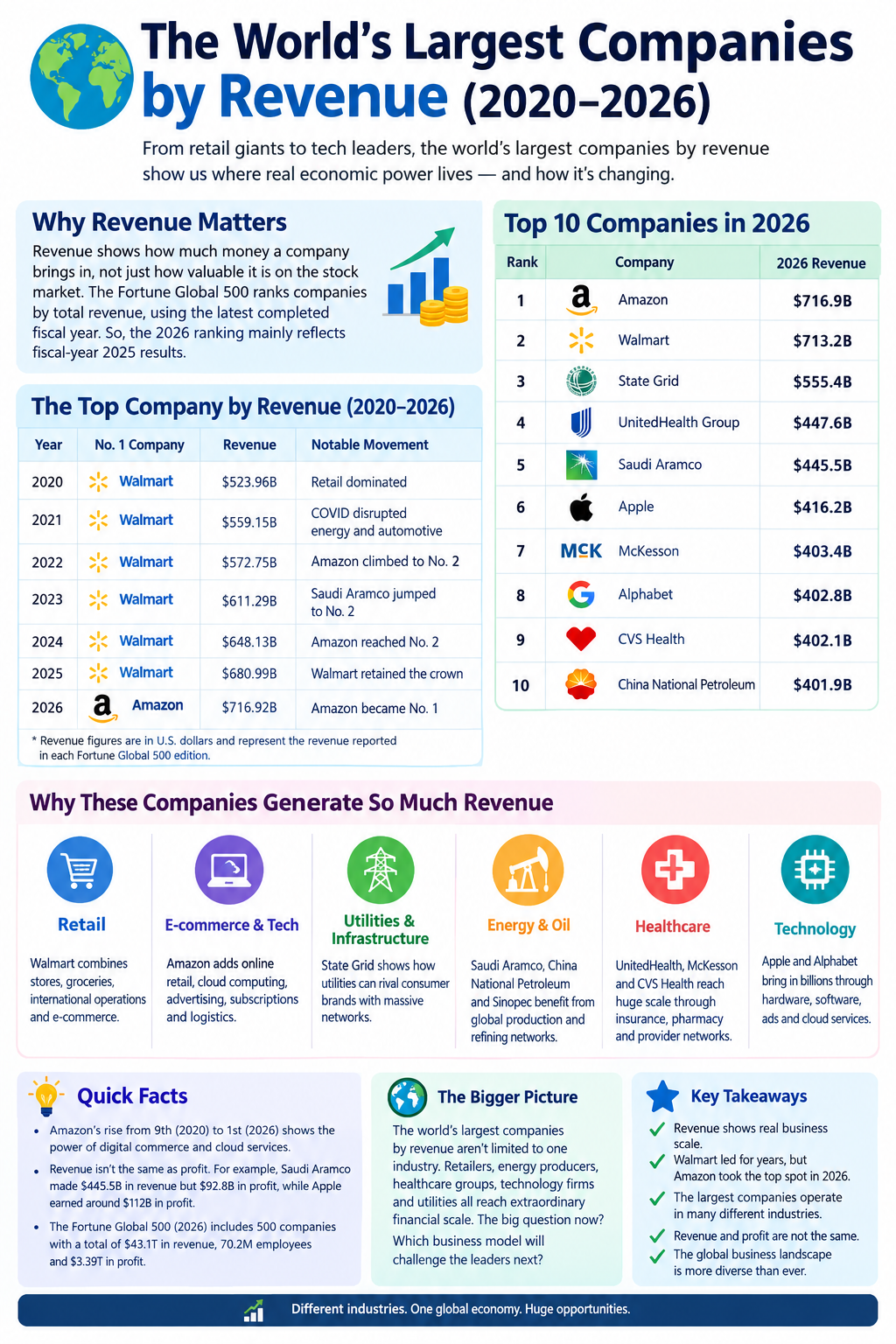
Revenue tells a different story from market value. A company can dominate headlines through its stock price while another quietly generates hundreds of billions through retail, energy, healthcare, or logistics. The world’s largest companies by revenue therefore offer a fascinating snapshot of where commercial power actually sits.
For this comparison, the Fortune Global 500 provides the most useful benchmark because it ranks corporations by total revenue rather than valuation. One important detail matters: each edition generally reflects the companies’ latest completed fiscal-year results. Therefore, the 2026 ranking largely represents fiscal-year 2025 performance. (Fortune)
The World’s Largest Companies by Revenue From 2020 to 2026
The last seven rankings reveal an extraordinary reshuffling at the top. Walmart held first place for years before Amazon finally broke the streak in 2026. Meanwhile, State Grid and several Chinese energy giants remained remarkably resilient. (Fortune)
| Fortune Year | No. 1 Company | Revenue | Notable movement |
|---|---|---|---|
| 2020 | Walmart | $523.96B | Retail dominated |
| 2021 | Walmart | $559.15B | COVID disrupted energy and automotive |
| 2022 | Walmart | $572.75B | Amazon climbed to No. 2 |
| 2023 | Walmart | $611.29B | Saudi Aramco jumped to No. 2 |
| 2024 | Walmart | $648.13B | Amazon reached No. 2 |
| 2025 | Walmart | $680.99B | Walmart retained the crown |
| 2026 | Amazon | $716.92B | Amazon became No. 1 |
Revenue figures are in U.S. dollars and represent the revenue reported in each Fortune Global 500 edition. (Fortune)
The world’s largest companies by revenue weren’t always technology giants. In 2020, Walmart led with $524 billion while Sinopec, State Grid, China National Petroleum, Shell, and Saudi Aramco occupied much of the upper tier. Amazon ranked ninth, showing how dramatically its position changed within only a few years. (Fortune)
Then came the pandemic shock. The 2021 Global 500 recorded aggregate revenue of $31.7 trillion, down 4.8% from the previous edition. Energy and automotive businesses suffered particularly sharp declines while Amazon surged to third place with $386.1 billion. (Fortune)
Top 10 Companies in 2026
The world’s largest companies by revenue now include an intriguing mixture of retail, technology, utilities, healthcare, energy, and pharmaceuticals. Amazon leads with $716.9 billion, followed by Walmart at $713.2 billion. State Grid takes third place with $555.4 billion. (Fortune)
| Rank | Company | 2026 Revenue |
|---|---|---|
| 1 | Amazon | $716.9B |
| 2 | Walmart | $713.2B |
| 3 | State Grid | $555.4B |
| 4 | UnitedHealth Group | $447.6B |
| 5 | Saudi Aramco | $445.5B |
| 6 | Apple | $416.2B |
| 7 | McKesson | $403.4B |
| 8 | Alphabet | $402.8B |
| 9 | CVS Health | $402.1B |
| 10 | China National Petroleum | $401.9B |
These figures highlight how unusual the modern corporate landscape has become. Amazon and Walmart each exceed $700 billion in annual revenue. Yet Apple, Alphabet, and Saudi Aramco demonstrate that enormous sales can emerge from completely different economic engines. (Fortune)
Why These Companies Generate So Much Revenue
The world’s largest companies by revenue tend to operate enormous commercial ecosystems rather than relying on one narrow product. Walmart combines physical stores, groceries, international operations, and e-commerce. Amazon adds online retail, cloud computing, advertising, subscriptions, and logistics to its sprawling business model.
Meanwhile, State Grid represents infrastructure on an almost continental scale. Its position illustrates why utilities can rival consumer-facing corporations despite receiving far less media attention. Energy companies follow a similar pattern. Saudi Aramco, China National Petroleum, and Sinopec benefit from gigantic production, refining, distribution, and fuel networks. (Fortune)
Another striking trend involves healthcare. UnitedHealth Group, McKesson, and CVS Health rank among the largest corporations despite operating in industries that many consumers rarely associate with enormous revenue. Their scale comes from insurance, pharmacy services, healthcare distribution, and extensive provider networks. (Fortune)
Technology has also become increasingly important. Apple and Alphabet now sit comfortably among the global revenue elite. Amazon’s rise is especially noteworthy because its business has expanded far beyond online shopping. Its cloud division, advertising operations, subscriptions, and marketplace ecosystem have created multiple revenue streams that reinforce one another.
The world’s largest companies by revenue also reveal why revenue shouldn’t be confused with profitability. Saudi Aramco, for example, generated $445.5 billion in 2026 revenue and approximately $92.8 billion in profit. Apple generated less revenue but considerably higher profit at roughly $112 billion. (Fortune)
Over the seven-year period, the biggest transformation has been Amazon’s ascent. It ranked ninth in 2020, third in 2021, second from 2022 onward in several editions, and ultimately seized first place in 2026. Fortune reported that Amazon’s $716.9 billion revenue ended Walmart’s long reign at the summit. (Fortune)
That change reflects a broader commercial shift. Digital commerce, cloud infrastructure, advertising technology, and sophisticated logistics have become powerful revenue engines. Still, traditional giants haven’t disappeared. Walmart remains just behind Amazon while State Grid continues to demonstrate the sheer economic weight of infrastructure.
Overall, the world’s largest companies by revenue show that corporate supremacy doesn’t belong to one industry. Retailers, energy producers, healthcare groups, technology firms, and utilities can all reach extraordinary financial scale. For readers tracking global business, the most interesting question isn’t simply who ranks first. It’s which business model will challenge the leaders next.
Source: Fortune Global 500 — 2026 ranking and methodology. Fortune’s 2026 edition reports that the 500 companies collectively generated $43.1 trillion in revenue during 2025, employed 70.2 million people, and produced $3.39 trillion in profit. (Fortune)