Introduction
The American job market is changing rapidly as healthcare needs expand, technology advances and renewable energy becomes increasingly important. New projections from the U.S. Bureau of Labor Statistics show that some occupations are expected to grow dramatically between 2025 and 2035.
The U.S. economy is projected to add approximately 5.9 million jobs during the decade, representing overall employment growth of 3.5%. However, some occupations are expected to grow far faster than the national average.
Healthcare dominates the list, while solar energy, wind power, data science and cybersecurity also feature prominently.
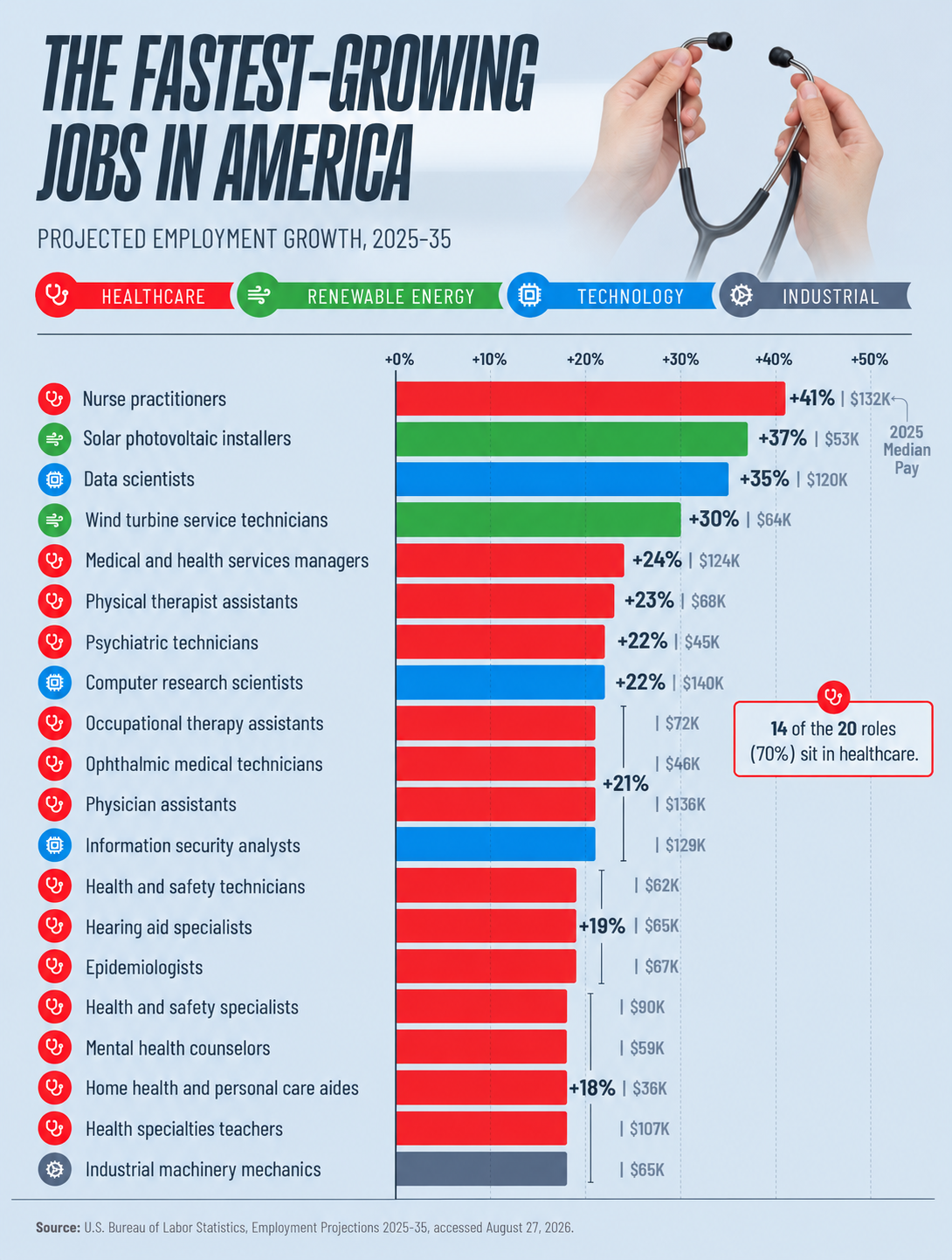
Here are the fastest-growing jobs in America through 2035.
Nurse Practitioners Lead America’s Fastest-Growing Jobs
Nurse practitioners are projected to have the fastest employment growth of any detailed occupation between 2025 and 2035.
BLS projects employment growth of 41%, with median annual pay of approximately $132,300 in 2025. Employment is expected to rise from about 336,000 positions in 2025 to roughly 474,000 by 2035.
The strong outlook reflects growing demand for healthcare services and the expanding role of nurse practitioners in team-based healthcare.
An aging population and increasing prevalence of chronic health conditions are expected to support demand for healthcare professionals throughout the decade.
Renewable Energy Jobs Are Growing Quickly
Renewable energy is another major part of America’s future employment landscape.
Solar photovoltaic installers rank second among the fastest-growing occupations, with projected employment growth of about 37% between 2025 and 2035. Their 2025 median annual wage was approximately $53,140.
Wind turbine service technicians rank fourth, with projected growth of approximately 30% and median annual pay of about $64,120.
The BLS expects electricity demand to increase significantly during the projection period, helping support demand for workers who install, maintain and service renewable-energy systems.
However, percentage growth does not always mean a huge number of new jobs. BLS projects that solar installers and wind technicians together will add fewer than 15,000 jobs through 2035 because both occupations start from relatively small employment bases.
Data Scientists Are Among America’s Fastest-Growing Careers
Data science continues to be one of the strongest technology career fields.
BLS projects employment for data scientists to grow by approximately 35% from 2025 to 2035. Median annual pay was about $120,230 in 2025.
Data scientists help businesses and organizations analyze large amounts of information, identify patterns and make better decisions.
The occupation combines mathematics, statistics, computing and analytical thinking, making it particularly relevant as companies increasingly depend on data and artificial intelligence.
Technology Jobs Continue to Expand
Technology remains another important source of high-growth employment.
Computer and information research scientists are projected to grow by approximately 22%, with median annual pay of about $140,300.
Information security analysts are also projected to grow by about 21%, with median annual pay of approximately $129,180.
These occupations reflect growing demand for advanced computing, cybersecurity, artificial intelligence and digital infrastructure.
As organizations collect more information and rely on increasingly complex digital systems, protecting data and developing new computing technologies become more important.
Healthcare Dominates the Top 20
The biggest theme in America’s employment projections is healthcare.
The BLS identifies healthcare support and healthcare practitioners and technical occupations as the two fastest-growing major occupational groups. They are projected to grow by 13.3% and 8.0%, respectively, between 2025 and 2035.
The aging population is one major reason.
Older populations generally require more medical treatment, rehabilitation, personal care and other health services. Chronic diseases and behavioral health conditions also contribute to demand for healthcare workers.
That explains why occupations such as physical therapist assistants, psychiatric technicians, occupational therapy assistants and physician assistants appear near the top of the rankings.
Top 20 Fastest-Growing Jobs in America
The following rankings are based on the latest BLS 2025–35 projections. Percentages and salaries below are rounded for readability.
| Rank | Occupation | Growth 2025–35 | 2025 Median Pay |
|---|---|---|---|
| 1 | Nurse practitioners | 41% | $132K |
| 2 | Solar photovoltaic installers | 37% | $53K |
| 3 | Data scientists | 35% | $120K |
| 4 | Wind turbine service technicians | 30% | $64K |
| 5 | Medical and health services managers | 24% | $124K |
| 6 | Physical therapist assistants | 23% | $68K |
| 7 | Psychiatric technicians | 22% | $45K |
| 8 | Computer and information research scientists | 22% | $140K |
| 9 | Occupational therapy assistants | 21% | $72K |
| 10 | Ophthalmic medical technicians | 21% | $46K |
| 11 | Physician assistants | 21% | $136K |
| 12 | Information security analysts | 21% | $129K |
| 13 | Occupational health and safety technicians | 19% | $62K |
| 14 | Hearing aid specialists | 19% | $65K |
| 15 | Epidemiologists | 19% | $87K |
| 16 | Occupational health and safety specialists | 18% | $90K |
| 17 | Mental health counselors | 18% | $59K |
| 18 | Home health and personal care aides | 18% | $36K |
| 19 | Health specialties teachers | 18% | $107K |
| 20 | Industrial machinery mechanics | 18% | $65K |
BLS’s underlying figures are slightly more precise—for example, epidemiologists are projected to grow 18.7%, while industrial machinery mechanics are projected to grow 17.8%.
Which Fast-Growing Jobs Pay the Most?
Fast employment growth does not necessarily mean high pay.
Among the 20 occupations shown above, computer and information research scientists have one of the highest median salaries, at approximately $140,300 per year.
Physician assistants have a median wage of around $135,880, while nurse practitioners earn approximately $132,300. Information security analysts have median annual pay of about $129,180.
This creates an important distinction for job seekers.
A career can have extremely high percentage growth but still have relatively modest wages. Solar photovoltaic installers, for example, are projected to grow 37%, but their median annual wage is approximately $53,140.
Why Are Healthcare Jobs Growing So Fast?
Healthcare demand is being influenced by several long-term demographic and social trends.
The American population is aging, increasing the need for medical treatment, rehabilitation, personal care and support services. At the same time, chronic diseases and behavioral health conditions continue to create demand for specialized professionals.
This is why healthcare appears repeatedly throughout the fastest-growing occupation rankings.
From nurse practitioners to physical therapist assistants and mental health counselors, many of these careers directly respond to expanding healthcare needs.
Why Are Renewable Energy Jobs Growing?
America’s energy system is also changing.
Solar and wind power have expanded significantly, creating demand for workers who can install, maintain and repair renewable-energy equipment.
The BLS expects solar photovoltaic installers and wind turbine service technicians to remain among the fastest-growing occupations through 2035.
The broader energy industry is also experiencing strong projected growth. BLS projections show solar electric power generation and wind electric power generation among the fastest-growing industries by employment percentage.
Artificial Intelligence Is Changing the Job Market
Artificial intelligence is becoming another important force behind employment changes.
AI is expected to support demand for some occupations while reducing demand for certain repetitive tasks. BLS says AI adoption can increase productivity in some areas while dampening employment demand in others.
For example, office and administrative support occupations are projected to decline by 4.0% between 2025 and 2035, with an estimated loss of about 752,100 jobs.
At the same time, technology occupations involving data, computing and cybersecurity remain among the fastest-growing fields.
This suggests that workers with strong analytical, technical and problem-solving skills may be particularly well positioned for the changing labor market.
Fast Growth Does Not Always Mean the Most New Jobs
One of the most important details about these rankings is the difference between percentage growth and total jobs added.
A small occupation can grow 40% while adding fewer workers than a much larger occupation growing 10%.
For example, home health and personal care aides are projected to grow by approximately 18%, but because the occupation already employs millions of people, BLS projects an increase of roughly 847,300 jobs between 2025 and 2035.
That is far more new positions than some occupations with higher percentage growth.
Therefore, job seekers should consider both growth rate and total employment opportunities when choosing a career.
What Should Job Seekers Focus On?
People planning their careers for the next decade should look beyond a single ranking.
Education requirements, salary, location, training time and the number of available openings can all influence whether a career is a good fit.
For example, BLS data show that nurse practitioners typically require a master’s degree, while solar photovoltaic installers typically enter the occupation with a high school diploma or equivalent and receive on-the-job training.
That makes these careers very different despite both appearing near the top of the growth rankings.
Technology careers can also have strong earning potential but often require specialized education and technical skills.
Are These Job Projections Guaranteed?
No.
BLS employment projections are not guarantees of what will happen. They represent long-term projections based on economic, demographic, technological and occupational trends.
Unexpected changes in technology, economic conditions, government policy, consumer behavior or other factors can alter the labor market.
The projections are therefore best viewed as a guide to where employment demand could be strongest through 2035.
Final Takeaway
The fastest-growing jobs in America through 2035 are concentrated in healthcare, renewable energy and technology.
Nurse practitioners lead the ranking with projected growth of 41%, followed by solar photovoltaic installers at about 37% and data scientists at approximately 35%.
Healthcare stands out as the biggest long-term employment story, while renewable energy and technology provide additional opportunities for workers with the right technical skills.
For anyone planning a career, the strongest strategy is not simply to choose the occupation with the highest percentage. Education requirements, salary, job openings and long-term demand should all be considered together.
FAQ
What is the fastest-growing job in America?
Nurse practitioners are projected to be America’s fastest-growing detailed occupation from 2025 to 2035, with employment growth of approximately 41%.
What are the fastest-growing jobs in America through 2035?
The leading occupations include nurse practitioners, solar photovoltaic installers, data scientists, wind turbine service technicians, medical and health services managers and physical therapist assistants.
Is data science a fast-growing career?
Yes. BLS projects data scientist employment to grow by approximately 35% from 2025 to 2035, with 2025 median annual pay of about $120,230.
Are renewable energy jobs growing in America?
Yes. Solar photovoltaic installers are projected to grow by about 37%, while wind turbine service technicians are projected to grow by about 30% between 2025 and 2035.
Which industry has the strongest employment growth?
Healthcare is one of the strongest areas. Healthcare support occupations are projected to grow 13.3%, while healthcare practitioners and technical occupations are projected to grow 8.0%.
Which fast-growing job has the highest salary?
Among the 20 occupations in this ranking, computer and information research scientists have a median annual wage of approximately $140,300 in 2025.
Will AI eliminate jobs?
AI is expected to change employment demand rather than simply eliminate all jobs. BLS projects stronger demand in some technology occupations while expecting automation and AI to reduce demand for some repetitive administrative work.
Are BLS job projections guaranteed?
No. BLS projections describe expected employment trends based on available economic and demographic assumptions. Actual employment can differ as conditions change.